Tuesday, January 13, 2009

Teotihuacan

One of the most famous pre-Hispanic sites in all the Americas is Teotihuacan, also known as the City of Quetzalcoatl (KWET sil KO i till), “the place where men became gods.” It’s about 50 km (31 miles) northwest of Mexico City. I took a bus from the Mexico Norte station. The trip lasted 30 minutes or so.

Teotihuacan’s origins go back to several hundred years before the birth of Christ. At its peak, it covered 20 sq. km. (8 sq. miles) and had a population of 200,000 people and was composed of different cultures. Around 600 AD it began to decline. Later on, the Aztecs worshipped it.

I began at the Avenida de los Muertos (Avenue of the Dead), which begins at the Ciudadela (Citadel), and goes all the way to the Pyramid of the Moon. In ancient times it stretched much further. The ciudadela, built around 200 ADD, contains the Templo de Quetzalcoatl, which was only discovered in the 1920s.

Without a doubt the main attraction is La Piramide del Sol (Pyramid of the Sun). Its base is as wide as the pyramids in Egypt, but it’s only half as high. Nonetheless, visitors to Teotihuacan climb 250 uneven steps to enjoy the view at the top.

At the end of the Avenida de Los Muertos is La Piramide de La Luna (Pyramid of the Moon). Unfortunately, visitors can only climb the first set of stairs. The view of entire complex is still spectacular. Next to the Pyramid is the Quetzalpapalotl Palace Complex, which was discovered in 1962. Inside are murals of birds and jaguars.


Japanese people flock to Teotihuacan.
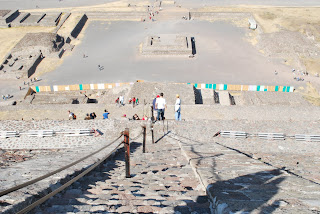
A view from the top of La Piramide de La Luna. It was worth the climb.

A view from the Ciudadela of La Piramide de La Luna (foreground) and La Piramide del Sol (background).

Monday, January 12, 2009

Tlaxcala/Cacaxtla

With a taxi driver, Miguel, I visited the city Tlaxcala, the capital of the state with the same name. I originally planned to stay here for a night, but the taxi driver told me it wasn’t worth it. He was right, but nonetheless, there were a few notable sites. We stopoped first at the Basilica de Ocotlan. Inside, the light was shining directly on the priest. We passed by the center of town, which is very pedestrian-friendly. The facades of the buildings are beautiful, and are well-preserved. The orange, red, and bright colors make it interesting. We walked though the main square (zocalo), which is surrounded by the Palace de Gobierno, and the Museo de Artes y Tradiciones Populares. I got a spectacular view of the city from the Convento de San Francisco.

On the way back to Puebla, Miguel and I stopped at Cacaxtla, another World Heritage site. Cacaxtla was once the home of the Olmeca-Xicalanca people. The pyramids (piramides) date from the 7th century here. There’s also a wonderful view of the Mexican basin, as well as the mountains.

Palacio Legislativo.

The tallest Christmas tree I've ever seen.

The Parroquia de San Jose.

The plaza of Tlaxcala. It's no wonder they call Tlaxcala La Cuidad Roja (The Red City).


Inside the Basilica of Ocotlan.

This Basilica de Ocotlan (oh kote LAWN)
Tlaxcala is famous for its bullfights (los toros).

I admired the beautiful colors of the center of Tlaxcala. It looks like Puebla.

This is Cacaxtla. After walking down a dirt path, visitors can explore the archaeological site and enjoy the view.

Sunday, January 11, 2009

Cholula

Since I had seen everything I wanted to see in Puebla, I took a bus to a neighboring city, Cholula. Cholula is famous for having 365 churches. That’s correct. There is one church here for each day of the year. I started my tour at Nuestra Senora de Los Remodios, which sits on top of a hill. It offers panoramic views of the city, and the three main mountains that surround Puebla: Popocatepetl (Po po ki TEP i till) and Iztaccihuatl (EEZ taw SEE wi till), and Merida. The church sits on top of the Zona Arqueologica, which houses the remains of the largest pyramid every built in Mesoamerica. The main attraction of Cholula, next to the plaza (zocalo), is the Convento de San Gabriel, which was founded in 1529. I’ve included a sample of the some of the other churches.


In this picture you can see two mountains: Popcatepetl (PO PO ki TEP i till) on the left, and Iztaccihuatl (EES tak SEE wi till) on the right. The former is active, the latter is not. Popcatepetl is 5465 meters high (17,930 ft) and Iztaccihuatl is 5230 meters high (17,160 ft). Legend has it that the warrior Popcatepetl fell in love with Iztaccihuatl. To woo her, he defeated his enemy in battle. Iztaccihuatl mistakenly believed he was dead. She then died of a broken heart. On seeing his dead lover, Popcatepetl turned both he and his lover into the two mountains that watch over Cholula and the lush Mexican basin. Neither is the tallest mountain in Mexico: that title belongs to Citlaltepetl (SEET la TEP i till), which is 5747 meters high (or 18,900 ft.)

This is a view of Cholula from Nuestra Senora de los Remedios, which is a church that sits on top of the largest pyramid ever built in the Americas.

Saturday, January 10, 2009

Puebla (de Los Angeles)

Puebla is another jewel in the heartland of Mexico. It’s the fourth-largest city in Mexico. It’s famous for fomenting the beginning of the 1910 revolution which overthrew the dictator Porfirio Diaz; its churches and mansions; its Volkswagen plant northwest of downtown; Talavera pottery, which is a fusion of Arabic, Spanish, Italian, and Chinese influences; mole, a Mexican dish which is a mixture of chocolate, almonds, chilis, spices, and fruit; and for being the site of the 1862 Battle of Puebla.

I started Saturday in downtown, a World Heritage site itself. I passed no less than 20 covenants, including San Cristobal, Santa Monica, and Santa Rosa. The main church is the Cathedral, which dates back to the 1600s, and is the second largest cathedral in Mexico. There was a mass when I entered so I couldn’t explore. I was disappointed that the principal site I wanted to visit was closed: The Biblioteca (library) Palafoxiana, which houses 50000 volumes.

I passed the stench of an outdoor seafood market, as well as Calle 6 Oriente, where vendors sell sweets and other confections. I stood in front of the Teatro Principal, the Museo de la Revolution Mexicana, which is supposedly where the 1910 revolution started, and then walked through the Barrio del Artista, or the Artist’s Quarter. Next to the Barrio del Artista is El Parian, a warren of activity and small shops selling blankets, post cards, and jewelry. I took a picture of the Casa del Alfenique, which is a sugar and almond paste which forms the plaster of the façade.

The next day I passed the Volkswagen plant on the way to the battle site of the Battle of Puebla, which took place May 5, 1862. The Mexican army led by Ignacio Zaragoza, along with Amerindians, defeated the French army, only to fall one year later. Today there’s museum there explains Mexico’s struggle of justice and independence.
Kevin

The outdoor seafood market in Puebla. The stench was overwhelming.


The main cathedral of Puebla. Downtown Puebla is a treasure. It's plaza and outdoor markets are pedestrian-friendly, and the architecture is incredible.


The central plaza of Puebla, adjacent to the Cathedral, and next to a warren of shops, restaurants, outdoor cafes, and outdoor stores.


The artesinal market, downtown Puebla.
The beautiful colors of Puebla. Some of these buildings are stores, some are homes.


El Teatro Principal. There are many theaters, but this one stands out for its beauty and history.


El Barrio de la Artista.


La Casa de La Alfenique


The museum at the site of the Battle of Puebla. The patio offers a great view of the city.

Friday, January 9, 2009

Cuernavaca: The Land of Eternal Spring

I used all of December 23 to travel to Cuernavaca. The trip from Guadalajara to Mexico City was seven hours (the equivalent of flying from Washington, D.C. to London), I had a two-hour layover in Mexico City, and then it was another two hours to Cuernavaca. I stayed with my great uncle, Guillermo Barraza Ortega, my father’s maternal uncle.
Guillermo lives alone most of the year, but when I arrived his friend, Tessy, was staying with him for the Christmas break. Originally from Buenos Aires, Argentina, she’s a professor of scientific methods of investigation at a university in Mexico City.

Cuernavaca is one of the oldest cities in Mexico, having been habituated since 1200 BC. Its name means nothing, but if it were Cuernovaca, it would mean “cow’s horn.” The center of the city is the Plaza of Cortes, flanked by Jardin Boda. The main cathedral of the city is also a World Heritage Site, with protection from UNESCO.

They call Cuernavaca La Tierra del Eternal Primavera, or the land of eternal spring. On Christmas Eve (Buena Noche), the temperature was 25 C (about 79 F) and the sky was clear. All the stores were open, and buses were operating as usual. I didn’t feel like Christmas wearing shorts and a dress shirt.

Cuernavaca doesn’t offer much for tourists, but it’s a great place to live. Besides the terrific climate, it’s clean, safe, and is close enough to Mexico City to take advantage of its culture and services, without having to live with the pollution, crime, traffic, or noise.


The Palcio del Gobierno, next to El Jardin Del Ninos.


Cuernavaca's other name.


The main cathedral of Cuernavaca. It almost looks medieval.

Kevin

Thursday, January 8, 2009

Zapopan

A few miles away from the center of Guadalajara is Zapopan, a wealthy suburb. The jewel of this suburb (colonia) is the Basilica, which is spectacular when illuminated at night. There are plenty of ritzy shops and clubs next to the Basilica.
Kevin

Tuesday, January 6, 2009

Tlaquepaque

This is another suburb of Guadalajara, famous for its artisans and crafts (pronounced TLAW kay PAW kay). In the heart of Tlaquepaque is a three-story market, and El Paletin, a collection of 34 bars (cantinas) and restaurants. There are couple churches here, a ceramics museum, and a
pleasant avenue for pedestrians.

Here you can see the parroquia, and a craftsmaker making personalized keys.

Kevin